
Fat freezing can produce a lasting reduction in a treated pocket of fat, but it cannot promise an unchanged body shape for life. Two separate questions matter: whether the local treatment effect persists, and whether you continue to like the contour as your body changes. The American Academy of Dermatology explains that destroyed fat cells are removed, while cells remaining in the area can enlarge with weight gain. AAD patient guide.
There is no evidence-based expiry date that everyone reaches. Equally, “permanent” should not be interpreted as a lifetime guarantee of a particular waistline, photograph or clothing fit.

Fat-cell reduction and body contour are different outcomes
Cryolipolysis uses controlled cooling to damage selected fat cells beneath the skin. The body clears damaged material gradually. Its purpose is local contouring: it does not treat obesity or deliver the health benefits of weight loss. FDA overview.
The treatment does not remove every fat cell from an area. That distinction explains why a genuine response and later fullness can coexist. Remaining cells can store more fat; losing some cells does not make the area unable to change. The AAD also distinguishes local fat removal from treatment of loose skin, which can require a different assessment. AAD patient guide.
When discussing durability, ask what the word “result” refers to. Is it a measured change in a local fat layer, a visible difference in shape or your satisfaction with the area? Those outcomes overlap, but they are not interchangeable. A photograph cannot count fat cells, and a local measurement cannot tell you how you will feel about your appearance years later.
What the long-term follow-up actually found
A 2016 report followed two men after treatment of one flank, leaving the opposite flank untreated for comparison. Photographs showed a persistent contour difference at six years in one man and nine years in the other, despite weight fluctuations. Three blinded reviewers correctly identified the baseline photographs. Bernstein, 2016.
That is encouraging evidence of durability in those individuals, not a typical duration for everyone. It was a two-person case series, limited to male flanks, using early CoolSculpting protocols and photographic assessment. The author disclosed membership of the manufacturer’s medical advisory board. The paper calls for larger long-term studies; it cannot establish a lifetime guarantee or predict outcomes across other devices and body areas. Study and disclosure.
The sensible consultation question is therefore not “Can you promise nine years?” It is “What supports the expectation you are giving me for this area and this device?” Ask for the uncertainty to be explained alongside the favourable examples.
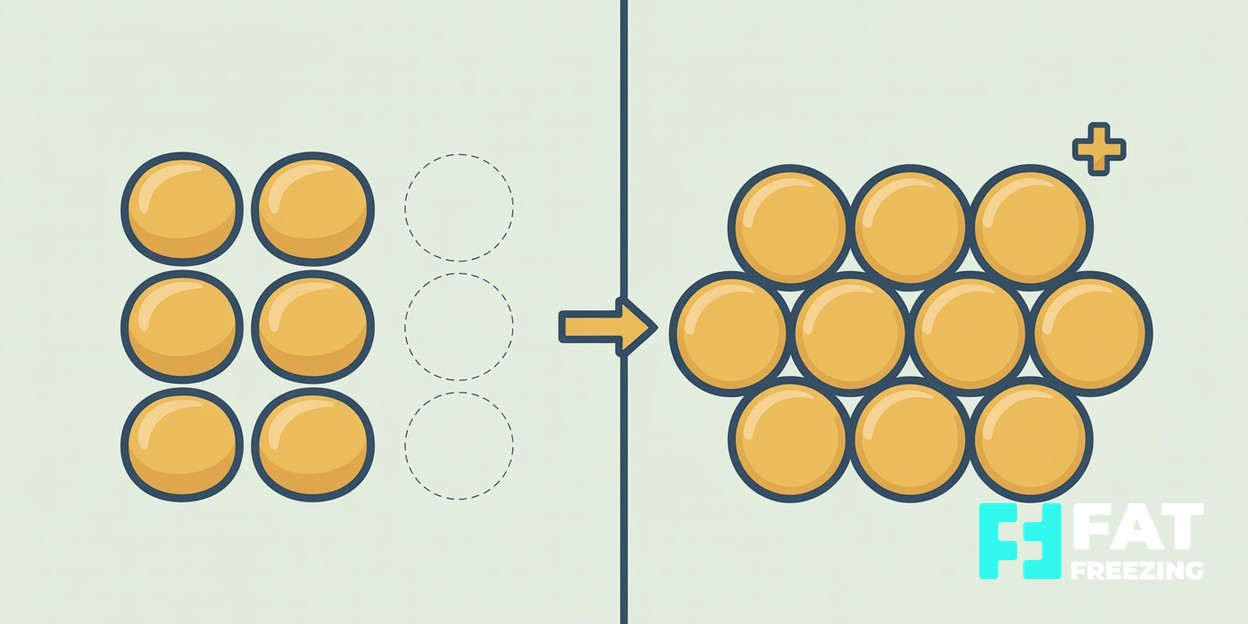
Conceptual illustration of changing fat volume; the symbols do not represent actual cell counts.
Why your shape can change afterwards
Weight gain can increase the size of remaining fat cells, including those in a treated area. A changed contour does not, by itself, show that the original treatment effect has disappeared. AAD explanation.
Ageing adds other changes. Muscle mass, posture and where fat is distributed can alter over time; body weight alone does not describe all of them. MedlinePlus: ageing and body shape. Skin also loses strength and elasticity as its connective tissue changes. MedlinePlus: ageing and skin. Taken together, these changes help explain why an old treatment result and a different-looking body years later are compatible.
This is not a reason to pursue an unchanging shape or blame yourself for normal ageing. It is a reason to define a realistic goal before treatment. If you are already planning substantial weight change, tell the practitioner: it may be more useful to reassess your concern later than make a contouring decision while that concern is changing.
Keeping a record of meaningful weight changes and previous procedures can help a later discussion. You do not need to judge yourself against one old image. Our guide to assessing before-and-after photographs explains how to make visual comparisons more useful.
Consider another treatment only after reviewing the first
An early lack of change and a change years later need different conversations. The response develops gradually, so agree a suitable review point with the treating practitioner. The branded CoolSculpting patient information explicitly recommends a follow-up assessment; its instructions concern that system and do not establish which equipment a clinic uses. Manufacturer Q&A. For the earlier stages, see our fat freezing results timeline.
Before agreeing further treatment, useful questions include:
- What changed after the first procedure, and how was that assessed?
- Is today’s concern a suitable fat pocket, or is another tissue contributing to its appearance?
- Has my health, weight or treatment history changed the suitability assessment?
- What extra benefit is realistic, and what would make you recommend waiting or stopping?
- What are the alternatives, including choosing no further procedure?
Pause if the first result has not been assessed, the explanation for a new contour is unclear, or the proposed benefit does not match your goal. Another appointment should have a specific rationale. A suggested yearly “maintenance” package is not evidence that your result has an annual expiry date.
A growing firm area needs assessment
Temporary redness, bruising, discomfort and numbness can follow treatment; numbness may last weeks. These are described in the manufacturer’s safety information.
A growing, firm bulge months later needs assessment rather than an automatic booking for more cooling. An uncommon complication, paradoxical adipose hyperplasia, causes treated fat to enlarge and harden. It does not normally resolve by itself and may require surgery. FDA complication guidance. Seek prompt assessment for blistering, marked colour change or severe or worsening pain; do not wait for a routine cosmetic review when symptoms concern you.
For a Nottingham consultation, bring your previous treatment details and explain what has changed. The Nottingham clinic is at Atomic House, 50 High Pavement, NG1 1HW. You can contact the team with questions about an assessment before deciding whether any further treatment makes sense.
Sources and further reading
- Bernstein EF. Long-term efficacy follow-up on two cryolipolysis case studies: 6 and 9 years post-treatment. Journal of Cosmetic Dermatology, 2016.
- American Academy of Dermatology: non-invasive fat removal.
- FDA: non-invasive body contouring technologies.
- MedlinePlus: ageing changes in body shape and skin.
- CoolSculpting UK: manufacturer Q&A and safety information.
Frequently Asked Questions
Does permanent fat-cell removal mean my shape stays the same?
No. Removing some fat cells does not fix the size of the cells that remain, prevent weight changes or stop skin and body composition changing with age.
Has fat freezing been followed up for more than five years?
Yes. A published report followed two men at six and nine years. Such a small series cannot establish how long results last for everyone.
Should I book yearly maintenance fat freezing?
A calendar alone is not a reason for further treatment. Review the original response, the current concern and suitability before considering another procedure.
What if a treated area becomes larger and firm?
Arrange an assessment rather than assuming ordinary weight gain. Paradoxical adipose hyperplasia is an uncommon complication involving enlargement and hardening of treated fat that may need surgery.

